
Construweek 2026: from the Bernabéu to Qiddiya, BIM in international megaprojects
Categories
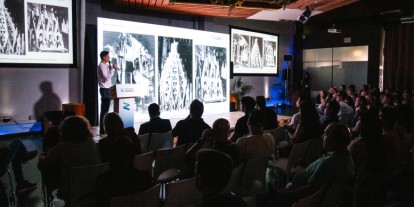
ZIGURAT Institute of Technology has held the ninth edition of Construweek, its annual event on digital transformation in the AECO sector. Under the title From model to reality: BIM in international megaprojects, the 2026 edition brought together three large-scale projects to show how digital information management can help address some of the challenges that arise when design, engineering and construction need to progress in a coordinated way.
The event travelled from São Paulo Metro Line 6 to the transformation of the Santiago Bernabéu and the future stadium in Qiddiya, before broadening the perspective to the urban scale of Qiddiya City. Three very different scenarios that share the same reality: thousands of data points, models, disciplines and decisions that need to remain connected throughout delivery.
São Paulo Metro Line 6
Pedro Rey, BIM Manager and Interface Manager at ACCIONA, opened Construweek by illustrating the digital scale of São Paulo Metro Line 6–Orange, a project comprising 15.3 kilometres of tunnels, 15 underground stations and 18 ventilation and emergency-access shafts.
The scale of the project is also reflected in its data: it has managed more than 2,000 BIM models covering different disciplines, areas and systems. To coordinate them, the team works with 152 federated models, bringing together information from 35 main disciplines and allowing architecture, structures, building services, railway systems and supplier models to be analysed jointly.
One of the distinctive aspects of the project was its restart in 2020 after several years on hold. To establish precisely what had already been built and continue the design, the team combined BIM with 3D scanning and point clouds, incorporating reality capture from the early stages and using it throughout construction to support decision-making and reduce risk.
The case also shows that technology alone cannot solve projects of this scale. During the Q&A session, Rey emphasised the coordination work carried out by BIM, engineering, construction and surveying teams: behind the technology, he noted, there is an intensive human effort involving analysis and attention to detail.
The Bernabéu: when the model also has to move
The presentation by Oscar Liébana, Director of ZIGURAT’s Máster en BIM Management (Spanish version of the Master’s in Global BIM Management), currently involved in the development of Qiddiya Stadium and previously in the Santiago Bernabéu project, took Construweek into the field of moving structures.
Liébana used the Bernabéu façade as an example. Its 13,500 stainless-steel slats are all different and were developed according to parametric criteria. The challenge was not simply to define their final geometry: the structure and roof deformed during construction, and the slats had to preserve the visual continuity of the façade while accommodating movements of up to 50 centimetres caused by factors such as temperature, wind and movement of the roof itself.
The stadium also had to remain operational for much of the redevelopment, with La Liga and Champions League matches affecting the construction schedule. Liébana therefore highlighted the role of 4D planning with a particularly clear statement: “4D is not something attractive simply to make a video to show; it is essential.”
Planning had to incorporate cranes, demolition works, roof installation, different construction phases and even the windows available between matches.
Another example shows how a single change can affect the entire system: the extension of the 360-degree video scoreboard added around 800 tonnes of load, requiring controlled support devices capable of generating approximately 200 tonnes of upward force without altering the behaviour of the steel structure.
For Liébana, this complexity also means moving away from the idea of a single BIM model: “A single model does not exist. The single model becomes a large common data environment containing many models in many different states, iterative and interconnected.”
That experience is now being transferred to the Prince Mohammed bin Salman Stadium in Qiddiya, where moving structures, large cantilevers and the need to anticipate deformation, vibration and different states of the building are once again part of the challenge.
Qiddiya: from project BIM to a virtual city
The final shift in scale came with Mohamed Dorra, Senior BIM Manager at Qiddiya, an alumnus of the Master’s in BIM for Civil Engineering and GIS and a ZIGURAT ambassador.
His presentation approached BIM from the client perspective and from the management of an entire portfolio of projects. Rather than focusing solely on modelling or clash detection, Dorra discussed how people, information, technology and processes need to be organised when management moves from a single building to an entire urban development.
One of the areas in which the team is already working is artificial intelligence. Dorra explained that his team has developed an agent that uses information from clash matrices to establish priorities, flag conflicts and even provide guidance on possible solutions. The aim is to enable team members who are not specialists to use this information as support during checking processes.
Reality capture is also connected to federated models and construction progress, using 360-degree cameras and AI tools to detect changes and generate information that can be accessed from the site.
The next step is a virtual city capable of feeding a digital twin solution and connecting construction, asset, IoT, mobility and other systems to enable simulations at urban scale.
Dorra summed up the philosophy behind this work in a statement that directly reflects the theme of Construweek 2026: “The model is not the destination; reality is the result.” In his view, an extremely detailed model loses its purpose if problems that could have been anticipated continue to emerge once construction begins.
From model to reality
Metro, stadium and city represent different scales and challenges, but the three experiences presented at Construweek 2026 point in the same direction: the value of BIM lies not only in creating a digital model, but in using information to make decisions throughout the project lifecycle.
This evolution was already at the heart of Construweek 2025, dedicated to Better Information Management, where different specialists examined how more rigorous data management can improve decision-making throughout the lifecycle of projects.
Construweek 2026 has now taken that conversation into the delivery phase: from thousands of models that need to be coordinated underground to structures that literally change position, and a city aiming to develop its own connected digital representation.