ZIGURAT Summit 2026 brings together more than 200 professionals in Barcelona
Categories
ZIGURAT Institute of Technology has held the fourth edition of the ZIGURAT Summit in Barcelona, an international event dedicated to analysing the main challenges facing architecture, engineering and construction in a context shaped by digital transformation, sustainability, artificial intelligence and the growing complexity of projects.
The event, held at Valkiria Hub under the theme “The Barcelona construction blueprint: from legacy to global challenges”, brought together more than 200 attendees and featured a high level of audience participation, with questions and reflections throughout the different sessions.
The event took place at a particularly significant moment for the city, in the year in which Barcelona holds the title of World Capital of Architecture 2026 and just a few days after the blessing of the Tower of Jesus Christ of the Sagrada Família, which, at 172.5 metres, makes the temple the tallest church in the world.
The opening session was led by James Basha, host of the event, CEO of Entreprelearners and lecturer on ZIGURAT’s MBA in Digital Transformation with AI, who recalled that Barcelona is a city of legacy, but also of innovation. In his address, he invited attendees to experience the day with intention and to take away at least one major learning to share later with their teams. He also highlighted ZIGURAT’s global impact, with more than 20,000 students from 120 nationalities and 270 international experts.
The Sagrada Família: legacy, technology and construction complexity
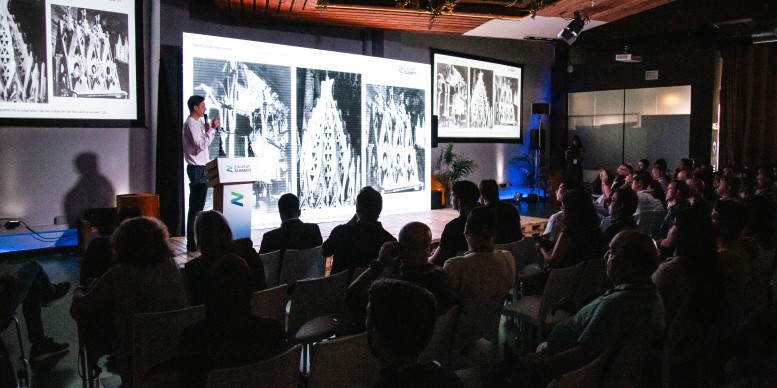
One of the highlights of the Summit was the session by Narcís Laguarda, ZIGURAT alumni and architect at the Sagrada Família Project Department, who shared images, videos and reflections on the technical, project-related and human complexity of working on a project of this nature.
During his presentation, Laguarda reviewed some of the key milestones of a project that began in 1882 and was later taken on by Antoni Gaudí, who transformed the original proposal and placed light, geometry, nature and spirituality at the heart of the temple. Gaudí devoted 43 years of his life to the Sagrada Família and developed much of his work through three-dimensional scale models, an empirical methodology that remains essential to understanding his architecture.
The session explained how, after the partial destruction of Gaudí’s workshop during the Spanish Civil War, his disciples reconstructed models and documentation in order to give continuity to the project. Laguarda showed how the works have incorporated technology over recent decades: from the introduction of CAD/CAM systems and parametric design between the late 20th and early 21st centuries to the advanced pre-industrialisation applied to the six central towers.
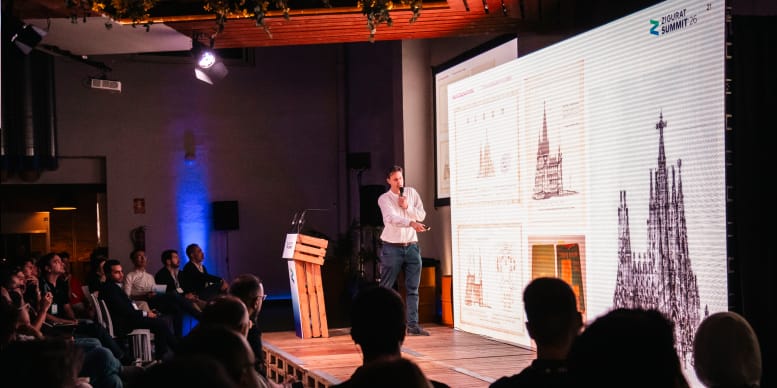
In this process, the team has worked with the ruled geometries already used by Gaudí, such as paraboloids and hyperboloids, and with construction systems capable of translating that formal complexity into buildable solutions. Among the examples presented, he highlighted the development of dry-assembled post-tensioned stone panels, with large-format pieces that reduce weight and facilitate assembly.
Laguarda also explained the “double twist” geometry used in the final cross of the Tower of Jesus Christ and the use of high-performance precast concrete elements in its construction. He also showed how drones, photogrammetry, laser scanning and point clouds are being used to document and restore elements such as the Nativity façade, with high levels of precision.
The session connected Gaudí’s legacy with current methods of design, digitalisation, manufacturing and construction, demonstrating that innovation applied to the AECO sector does not replace craft and design knowledge, but expands it and enables the continuity of works of extraordinary complexity.
Cities with memory: the Digital Twin of the Barcelona Metropolitan Area
The programme also addressed the role of digital models in urban management. Montserrat Monteagudo, Director of Cartographic Innovation Projects at AMB, and Andrea Contreras, architect at AMB’s BIM Office, presented the case of the Digital Twin of the Barcelona Metropolitan Area as a living asset for territorial management.
The session showed how the Barcelona Metropolitan Area, made up of 36 municipalities, 636 km² and 3.35 million inhabitants, has advanced in the integration of GIS and BIM to generate more precise, interoperable and useful territorial models for urban planning, conservation and public space management.
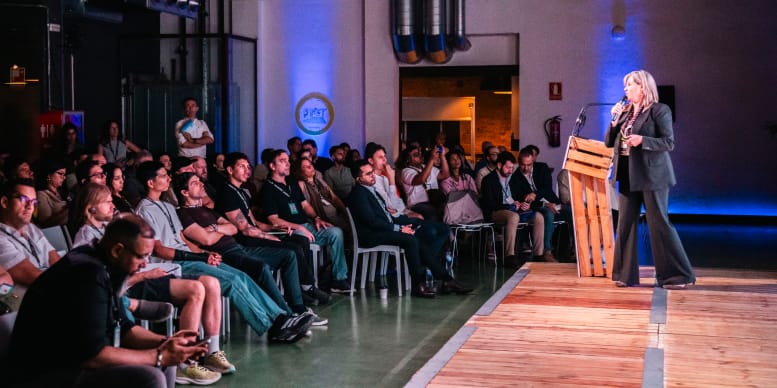
The speakers explained how AMB began by publishing 3D models of the territory and how, in 2023, it took a significant step forward with the open publication of IFC-format models. This work has made it possible to transform cartographic databases into BIM volumes and to insert AECO-sector projects into a real urban context.
They also presented the combined use of traditional surveying, mobile mapping, point clouds and automation to update cartographic information and capture urban elements with greater precision. These advances make it possible to simulate shadows, design streets in greater detail and improve decision-making around public space.
Industrialised timber, sustainability and measurement: the Witty Wood case
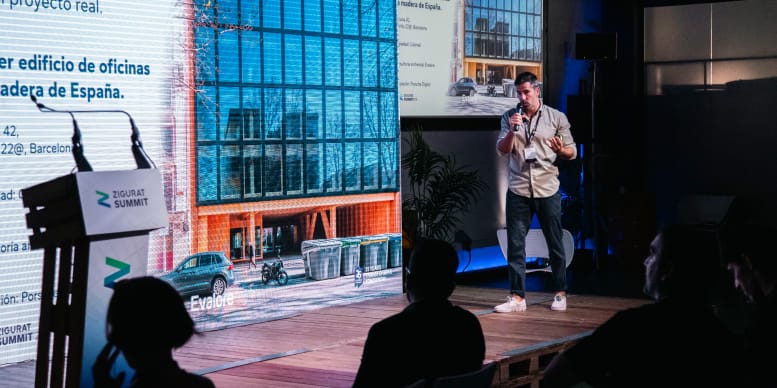
Sustainability was another of the major themes of the day, with a session by Pablo Muñoz, co-founder and CEO of Evalore, focused on the role of timber as a contemporary construction material.
Under the question “A return to origins or cutting-edge technology?”, Muñoz argued that timber does not belong to the past, but can become a high-performance industrialised system when combined with engineering, prefabrication, quality control, structural calculation and technical feasibility criteria. At the same time, he stressed that it is not a universal solution and cannot be applied automatically to every project.
During his presentation, he addressed some of the main myths associated with timber. He explained that it cannot be considered a completely carbon-neutral material, due to the impact of transport, processing and manufacturing, but he highlighted its capacity to store biogenic carbon during its life cycle and to reduce emissions compared with conventional solutions when applied under the right strategy.
He also discussed its behaviour in the event of fire, noting that timber burns in layers and in a predictable way, which allows its structural response to be calculated and safe solutions to be designed. The key, he insisted, is not simply to use timber, but to measure, compare and justify its impact through life cycle assessment, life cycle cost analysis, energy simulation and environmental certification criteria.
The session included the case of Witty Wood, the first timber office building in Spain, located in Barcelona’s 22@ district and certified LEED Platinum. Muñoz explained that the building’s structure was erected in six weeks and that, although timber involved a structural cost increase compared with other solutions, it reduced construction times and accelerated the commercialisation of the asset, financially offsetting the operation.
Lean and artificial intelligence to manage increasingly complex projects
Artificial intelligence and Lean methodologies were the focus of the session by Ahmed ElHadidi, Project Manager & Design Management Leader at WSP Middle East and ZIGURAT mentor.
His presentation was based on a central idea: project complexity is growing faster than teams’ capacity to manage it. In this context, ElHadidi defended the combination of Lean and artificial intelligence as a way to reduce waiting times, rework, errors, unnecessary documentation and knowledge loss within workflows.
“AI will not replace us, but someone using AI might,” he said during his session. From this reflection, he explained the evolution from basic uses of AI, such as data extraction or prompting, towards more advanced systems based on RAG and agents capable of carrying out repetitive tasks, reviewing information, checking requirements and assisting decision-making.
ElHadidi presented use cases linked to automated planning, schedule generation, 4D construction sequencing and design auditing. Among the examples, he showed how tools developed in project environments can absorb the requirements of major operators, review models and flag possible non-compliance before it creates commercial or execution risks.
His main message was that Lean helps define value and detect waste, while AI makes it possible to scale that analytical and response capacity. However, he insisted that companies must first assess their level of readiness before adopting tools indiscriminately. In his words, the human must remain the pilot and artificial intelligence the co-pilot.
Mutant stadiums and new complex systems
The Summit also featured Óscar Liébana, Design Manager at FCC and Director of ZIGURAT’s Master en BIM Management, who addressed the technological challenge of so-called “mutant stadiums” through major projects such as the New Bernabéu and Qiddiya.
His presentation showed how this type of infrastructure can no longer be understood as static buildings, but as complex systems in which mobile structures, retractable roofs, envelopes, automation, building services, user flows, urban requirements and new operating demands interact.
In the case of the Santiago Bernabéu, Liébana explained how the new structure rests on the old one and how the challenge is not only to model, but to anticipate the behaviour of a building that moves and transforms. The mobile roof, the video scoreboard and the façade interact constantly, while the thousands of fins in the envelope require parametric solutions and mechanical systems capable of absorbing tolerances.
He also presented the complexity of the Qiddiya stadium in Saudi Arabia, conceived as a large-scale infrastructure located on a cliff and integrated with mobile elements, LED screens and new operating systems. Based on these cases, he argued that the response to complexity does not depend only on technology, but also on methodology, creativity, curiosity, team coordination and the ability to ask the right questions at the right time.
“Forget about single models,” he said during his presentation, explaining how these types of projects involve working with numerous models in constant movement and iteration. According to Liébana, these developments require buildings to be understood as organic systems, capable of adopting different physical and functional positions throughout their life cycle.
Technical leadership: stop being the bottleneck
The day concluded with a round table on technical leadership moderated by James Basha, with the participation of Fernando Iglesias, Head of Innovation and BIM Manager at Kronos and Director of ZIGURAT’s Máster en Inteligencia Artificial para Arquitectura y Construcción, and Vicki Reynolds, Director of ZIGURAT’s Master’s in Global BIM Management. The conversation addressed one of the major challenges for architects, engineers and highly specialised profiles: the transition from technical positions to management and leadership roles.
During the session, the panel analysed why some professionals with strong technical capabilities struggle when taking on leadership responsibilities. Iglesias stressed that many technical profiles tend to identify their value with solving problems directly, while leadership requires precisely the opposite: to stop being the bottleneck and create a framework in which the team can generate solutions.
Reynolds, for her part, emphasised the need to abandon technical ego and accept that leading means not always being the most expert person for every task. The challenge lies in building trust, delegating, developing collective judgement and accepting the discomfort of creating space for other profiles.
The panel agreed on the importance of soft skills, communication, emotional intelligence and psychological safety in building teams capable of learning, failing and improving without fear. One of the key lessons shared was the need to listen in order to understand, not simply to respond better.
A meeting point for the international AECO community
In addition to the presentations and panel discussions, ZIGURAT Summit 2026 included networking spaces and a breakfast break that allowed attendees to exchange impressions with speakers, professionals and representatives from participating companies and institutions.
The event consolidated the Summit as a meeting point for architects, engineers, technicians, executives and specialists interested in the technologies, methodologies and management models redefining the future of the built environment.
With this fourth edition, ZIGURAT reinforces its commitment to applied education, industry connection and reflection on the major challenges facing the AECO sector, from Barcelona to a global conversation on the future of construction.