Construweek 2025: the real impact of Better Information Management on complex infrastructure
Categories
-default-777x388.jpg)
The English-language session of Construweek 2025, ZIGURAT Institute of Technology’s annual event, has offered an advanced perspective on how the AECO sector is evolving from traditional BIM towards a more rigorous approach to information management: Better Information Management. The session focused on the strategic role of data in large-scale projects, such as the HS2 high-speed rail network and public education infrastructure.
During the opening session, Taisa Figueroa, Institutional Relations at ZIGURAT, highlighted the aim of the event: “We want to rethink how we use information in construction. Today, modelling well is no longer enough: we need to manage data intelligently in order to make better decisions throughout the entire asset lifecycle.”
Better information to reduce emissions and costs
The first session, focused on architecture and buildings, featured Vicki Reynolds (Technical Director at One Creative Environments and Director of the Master’s in Global BIM Management) and Melanie Robinson (Associate at Okana and Regional Lead at Women in BIM). Both shared real-world examples demonstrating how effective information management can translate into tangible savings, a lower environmental impact and an improved quality of life.
Reynolds presented two projects: the digitalisation of her company’s headquarters and the transformation of a consortium of 32 schools in the UK. In both cases, digital twins connected to sensors and structured information were used to support better-informed decisions. “With accurate, well-organised data, we managed to reduce our annual energy bill by 75% and radically improve the user experience,” she explained. She also stressed the importance of clients “owning their own digital systems, rather than depending on closed solutions”.
Robinson, meanwhile, highlighted the impact of information quality on safety, sustainability and operations: “Having digital data is not enough. It needs to be structured, up to date and aligned with the real objectives of the asset.” Among the examples she presented were data structuring work at the Sydney Opera House and at a mine in Greece, where “improving the existing information was the starting point for genuine digital transformation”.
HS2 as an example of large-scale data integration
The second session focused on HS2, the UK’s new high-speed railway. James Daniel (Head of Digital Engineering at HS2 Ltd and Director of ZIGURAT’s Master’s in Global BIM Management in Civil Engineering and GIS) and Andrew Robinson (Program Director at Bentley Systems) explained how a project involving more than 2 million digital assets, 30,000 people across the supply chain and 3,500 partner organisations can be managed efficiently through a robust and shared digital strategy.
Daniel explained how a common data platform and a unified visualisation system enable the entire supply chain to work from a single source of truth: “We have created an environment where all stakeholders can collaborate in real time, with verified and accessible information. It represents a paradigm shift in the management of complex projects.”
They also presented tools developed with Bentley, including the Collaboration Hub and Visualization Hub, which bring together BIM models, documents, GIS, IoT sensors and 4D planning within a single interface. “It is not about using technology for technology’s sake, but about solving specific needs with reliable data,” Robinson noted.
Moving beyond traditional BIM
The English-language edition of Construweek 2025 confirmed a clear trend: the future of digital transformation in construction is not simply about modelling in 3D, but about strategically managing data throughout the entire asset lifecycle. As Daniel summarised: “The real challenge is not only to model, but to structure, verify and share the information that genuinely creates value.”
In doing so, ZIGURAT continues to consolidate Construweek as an international reference point for professionals seeking to move beyond traditional BIM and lead a new era of construction based on data, collaboration and efficiency.
For more information, you can access the full Construweek 2025 session in English.
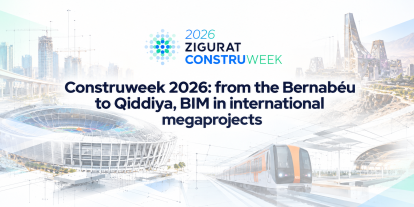
In 2026, Construweek continues this conversation by focusing on the application of BIM in international megaprojects such as Qiddiya City, the Santiago Bernabéu and São Paulo Metro Line 6.
Related module
Master’s in Global BIM Management
English
1 academic year