What does a community actually need when disaster strikes?
When we began exploring the potential of community resilience hubs in Portland, Oregon, we expected technology, infrastructure and emergency preparedness to be central to the discussion. But when we asked local school communities what mattered to them, they did not talk about resilience in the abstract.
They talked about three things: communication, energy and mobility.
Communication, in particular, often meant something even more fundamental: safety. People wanted to know how to stay in touch, where to find reliable information and who to call when something went wrong.
That discovery reshaped the project. It also led to a broader lesson that remains central to our work today: cities should not start with technology and then look for a problem to solve. They should start by understanding what communities actually need.
Several years after our original project, our approach has evolved. Digital twins and smart technologies remain relevant, but our focus has increasingly shifted towards energy security, community governance and infrastructure that provides value not only during emergencies, but every day.
What is a community resilience hub?
A community resilience hub is a trusted local facility designed to support residents and coordinate essential services before, during and after disruption.
Unlike a conventional emergency shelter, a resilience hub should not sit idle waiting for the next disaster. Its value is greater when the same infrastructure contributes to everyday community life through energy services, education, communications, workforce development or other local programmes.
This everyday function matters for both resilience and long-term viability. Infrastructure that only proves its value during an occasional emergency can be difficult to fund and maintain. Infrastructure that reduces energy costs, supports learning, provides community services and strengthens local capacity has a reason to remain active between crises.
At a wider urban scale, these local systems can form part of broader strategies for strengthening urban resilience across infrastructure, governance and communities.
From a ZIGURAT Master's project to community research in Portland
The project originated as a Final Master's Project that I developed through ZIGURAT's Master's in Global Smart City Managementtogether with Mahmoud Adly, Mohamed Omar, Dan O'Brien and Mohammad Alzayd.
The original Schools as Community Resilience Hubs project explored whether schools, digital twins and smart technologies could help bridge the gap between professional emergency response and the communities affected by disasters.
The initiative subsequently developed into a project led by Georgia Tech and partners within the Global Community Technology Challenge. In 2022, it received an NSF Planning Grant through the Civic Innovation Challenge to investigate a community-led framework for adapting a public school in Portland into a Community Resilience Hub supported by digital-twin technologies.
The full resilience hub envisaged in the original proposal was ultimately not completed. But the discovery process with local school communities produced something particularly valuable: it challenged some of the assumptions on which the original project had been based.
First lesson: communities do not ask for "resilience"
One of the strongest findings was also one of the simplest: communities do not ask for resilience. They ask for communication, energy and mobility.
When residents talked about communication, the underlying issue was often safety: staying connected with family, receiving reliable information and knowing whom to contact during an emergency.
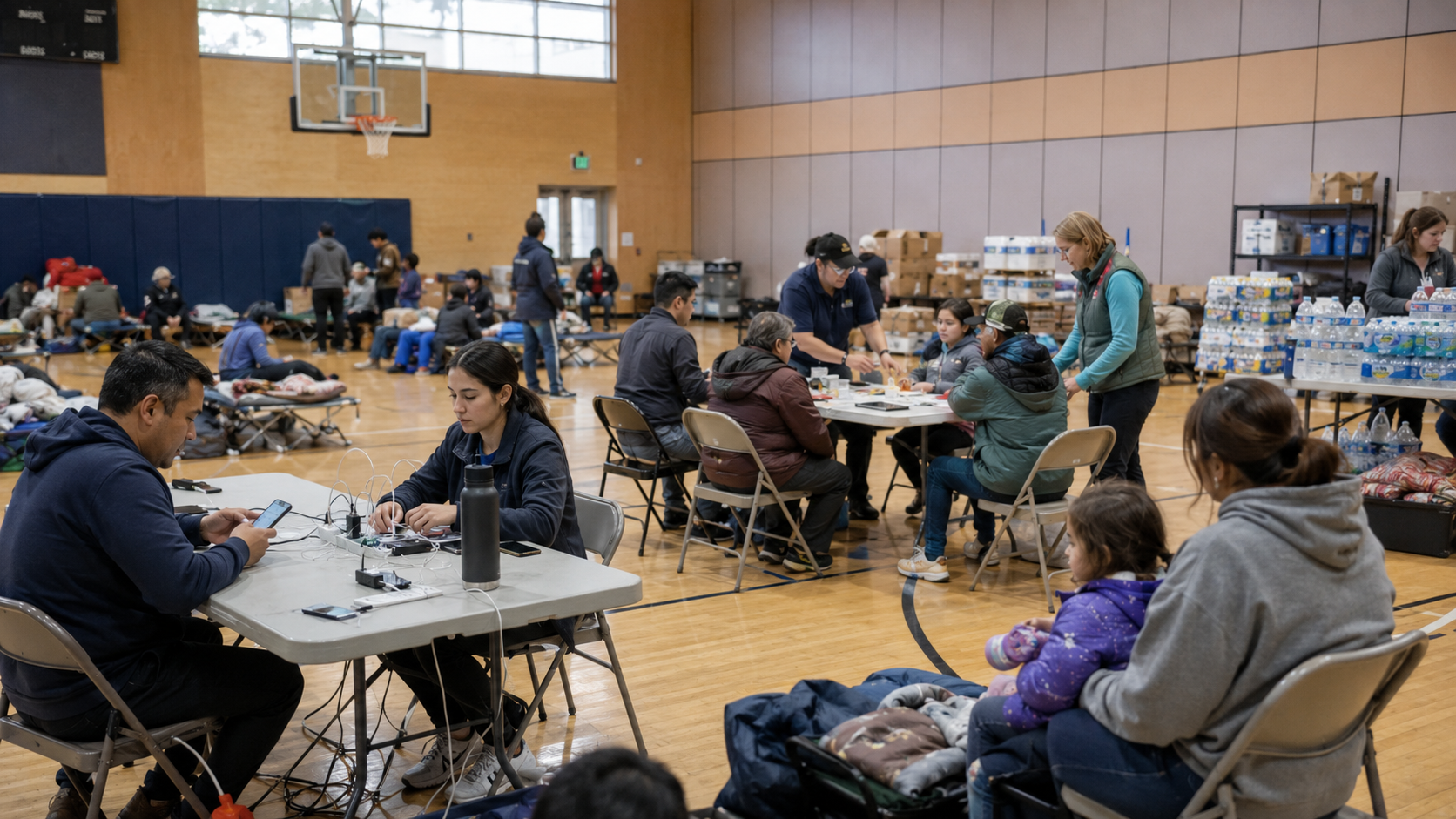
Energy also translated into very practical questions. Will electricity remain available? Can people charge a phone or medical device? Will heating or cooling continue to work? Can essential services keep operating?
Mobility means knowing whether people can reach support and whether key routes remain usable.
These are more useful starting points than asking a community which smart technologies it wants. A resident may never ask for a digital twin, a microgrid or an integrated data platform. They may ask for reliable power, a safe place during extreme heat or a way to communicate during an outage.
The technical programme should follow those needs — not define them in advance.
Why schools can become effective community resilience hubs
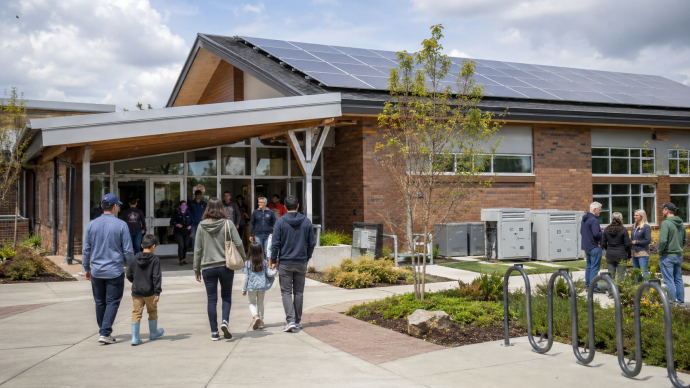
Schools have several characteristics that make them particularly suitable as community resilience hubs.
They are widely distributed, publicly recognised and embedded in neighbourhood life. They typically provide classrooms, kitchens, gymnasiums, communication systems, parking and outdoor spaces. Most importantly, they are familiar places that residents know how to reach.
Their geography also matters. A network of neighbourhood schools can approximate a network of walkable catchment areas, bringing resilience infrastructure closer to the people who may need it.
With targeted upgrades, a school could act as a learning facility, workforce-development space or energy-demonstration site during everyday operation. During disruption, it could potentially become a heating or cooling centre, communications node, charging point, food distribution location, emergency shelter or microgrid-supported refuge.
But our experience revealed an important limitation: the building itself is rarely the main obstacle.
School districts can operate separately from municipal governments and have their own liability, insurance and capital-investment requirements. A technically suitable building does not automatically create an implementable resilience hub.
The school district therefore needs to participate from the beginning, rather than being approached later simply as the owner of the building.
One lesson we underestimated was that governance can be a harder problem than technology.
From resilience hubs to community energy hubs
The context surrounding the project has also changed.
In my current work in North America, I see the centre of gravity moving increasingly towards energy security. Growing electricity demand — including demand associated with data centres — and the development of Distributed Energy Resources (DERs) are creating new opportunities for local energy systems and microgrids.
This creates a different way of thinking about a resilience hub.
Rather than investing in an asset that waits for an emergency, the model we are now developing combines resilience with a community energy hub capable of producing measurable value under normal conditions.
The framework brings together four elements:
a coordinated community energy system;
a trusted, public-facing institution;
digital infrastructure;
and a durable community governance model.
At neighbourhood scale, the anchor can be a school. At a larger commercial scale, it could be an adaptive-reuse building with significant computing or energy demand, connected to a school or civic institution acting as the community-facing node.
The objective is not simply to install more technology. It is to convert infrastructure investment into outcomes communities can experience: affordability, reliability, learning, local economic opportunity and greater civic capacity.
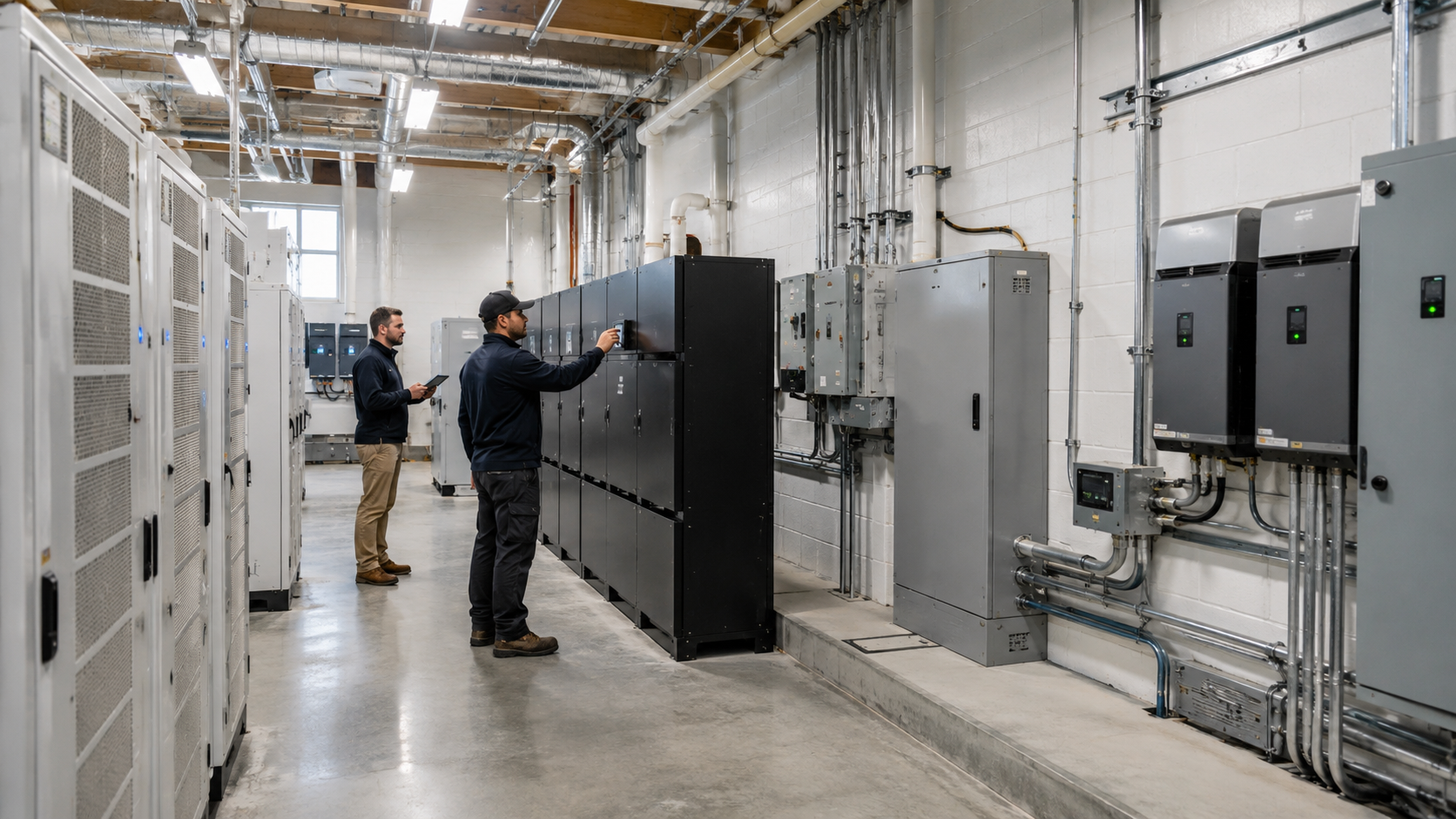
Solar generation and battery storage, for example, can potentially reduce energy bills or provide services to the electricity system while also supplying backup power during disruption.
In practical terms, a hub has to earn its keep on ordinary days.
How can digital twins support resilience hubs?
Digital twins remain an important part of the model, but their purpose needs to be clearly defined.
Their greatest value may come before a disaster occurs, when planners still have the opportunity to test assumptions and make different decisions.
Before a disaster: planning and testing
A digital representation of a building, neighbourhood or infrastructure system can help planners determine:
where resilience hubs are most needed;
how many people they should serve;
how much backup power and storage are required;
how far residents would need to travel to reach support;
and how scenarios such as heatwaves, floods, earthquakes or prolonged outages could affect local infrastructure.
Most importantly, digital modelling can turn a broad promise of "resilience" into measurable requirements:
How many people? How much power? For how many hours? Within what distance?
Those are questions that can eventually be tested against real performance.
During a disaster: understanding what is happening
During an emergency, digital systems could provide information about which hubs remain operational, how much stored energy remains, which routes are usable or where assistance is needed most urgently.
But a resilience system cannot assume that all its digital infrastructure will continue working. Sensors may fail. Communications may go down. Data may be incomplete.
Digital systems should therefore be accompanied by manual controls, backup procedures and alternative communication methods that have been tested beforehand.
After a disaster: measuring what actually worked
After disruption, operational data can help determine what happened, what failed and which services should be restored first. It can also compare actual performance with assumptions made during planning, creating a feedback loop that improves both the digital model and the emergency plan.
A digital twin should also function as a shared planning and accountability tool, rather than becoming a private dashboard controlled exclusively by a developer or technology provider.
This is where interoperable digital infrastructurebecomes particularly important: cities and communities need information that can move between systems and remain usable beyond an individual technology supplier.
Community data needs to remain accessible, understandable, appropriately protected and usable by the people and institutions the system is intended to serve.
Four barriers to implementing resilience hubs
The technical components of a resilience hub already largely exist. Implementing them successfully requires solving four less visible problems.
1. Governance: who decides and who operates?
In my experience, governance is the most difficult challenge.
Community energy systems require continuous professional management. Someone needs to monitor energy use, operate batteries and other equipment, protect data, comply with regulations and potentially manage financial transactions.
It is unrealistic to expect a voluntary neighbourhood organisation to manage infrastructure of this complexity.
A more viable model separates community governance from professional operation. The community establishes goals, priorities and standards. A professional organisation operates the infrastructure and fulfils its technical and legal obligations, while remaining accountable to the community and replaceable if it does not perform.
Community control does not require residents to become energy-system operators.
2. Funding: create value between emergencies
The greatest benefit of resilience infrastructure may only become visible during an occasional emergency. That makes conventional funding difficult: capital may be available to build infrastructure without guaranteeing the money needed to operate and maintain it for decades.
Making the same assets useful every day changes the equation.
Energy savings, grid services, educational programmes, workforce development and community uses can all contribute to a more durable model.
3. Technology: avoid vendor dependency
The question is no longer whether the individual technologies exist, but whether they can work together and whether the community retains meaningful control.
Open and interoperable systems allow organisations to access their own information and change suppliers when necessary. Closed systems risk creating long-term dependency on a single vendor.
In that sense, interoperability itself becomes part of resilience.
4. Community engagement: participation must begin early
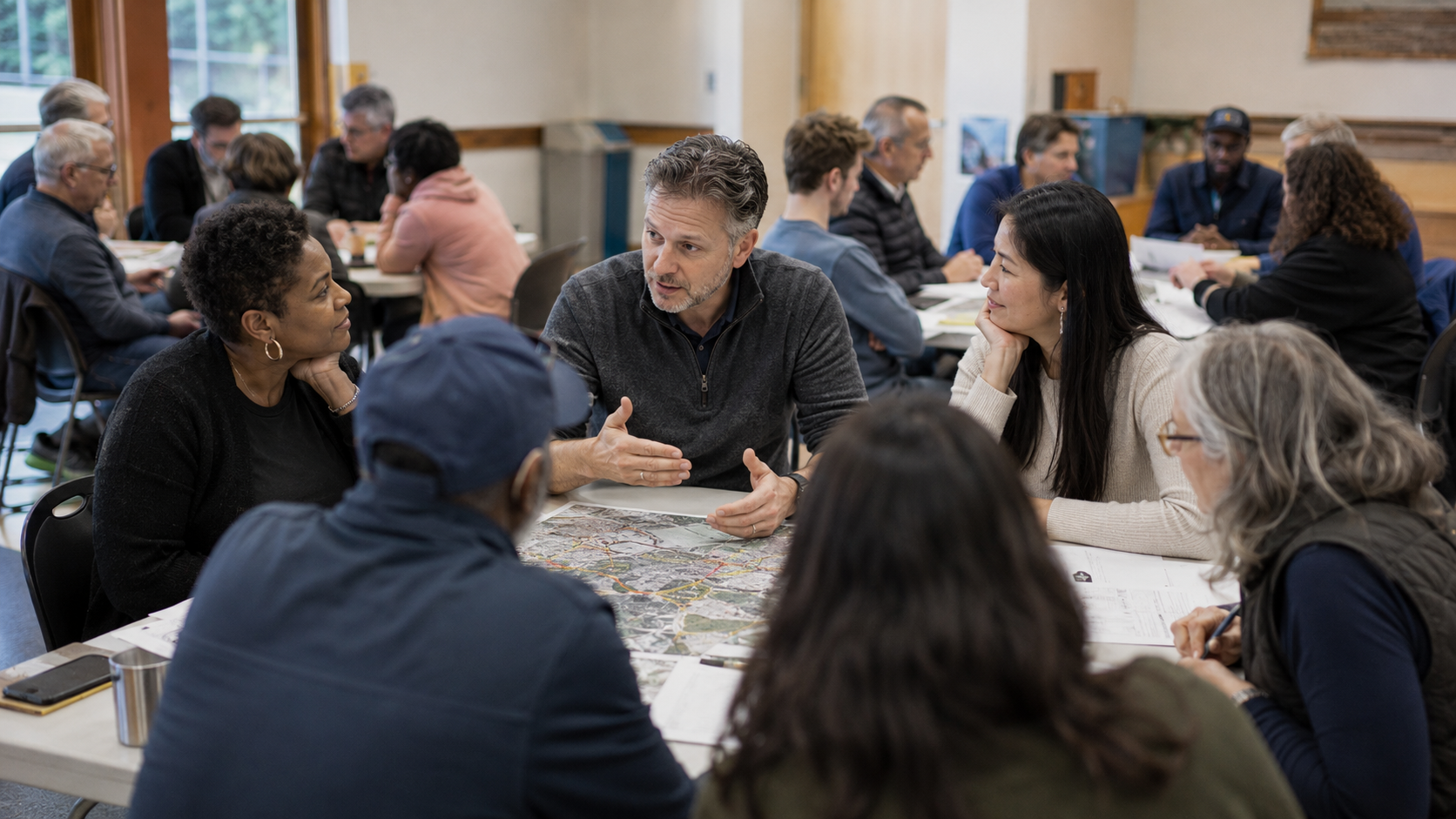
Residents should help define the problem before the location, design and technology have already been selected.
Consulting a community at the end of the process is not the same as allowing it to shape the project.
Meaningful participation means deciding together what infrastructure is needed, whom it should benefit and how its costs and benefits should be distributed.
Five lessons for cities planning community resilience hubs
Looking back at the project, I would approach three decisions differently today: I would design governance alongside the technical solution, work with a specific building and counterpart much earlier, and define measurable outcomes from the beginning rather than trying to quantify vague promises afterwards.
For cities considering a network of resilience hubs, I would summarise the lessons in five principles:
Do not start with technology. Start with discovery and identify the problems the community itself considers important.
Name the operator before buying the assets. Decide who will run the system, under what mandate and to whom the operator will be accountable.
Make the hub useful on ordinary days. Energy savings, education, workforce development and community services help infrastructure survive beyond individual funding cycles.
State resilience in numbers. Define hours of backup power, people served, loads supported and maximum travel distances — and measure the results afterwards.
Be for something. Opposition alone does not create an alternative. Communities seeking influence over infrastructure decisions also need credible proposals for what they want instead.
From smart technology to civic infrastructure
The project began by asking how smart technologies and digital twins could strengthen community disaster preparedness.
Those technologies still matter. But several years of work have shifted the emphasis.
The stronger model combines trusted local institutions, measurable everyday value and clear responsibility for governance and operation.
Schools can provide the physical and social anchor. Microgrids and distributed energy can strengthen operational independence. Digital twins can help test scenarios and measure whether promised outcomes are being delivered.
But none of those elements works in isolation.
A community resilience hub is therefore more than a building equipped for emergencies. At its best, it becomes a piece of civic infrastructure that contributes to everyday life while giving communities greater capacity to respond when ordinary systems fail.
References
National Science Foundation — CIVIC-PG Track B: Digital Twin-based Framework for Development of Schools as Smart & Connected Community Resilience Hubs, Award 2228679.
OpenCommons — School Organized Locally Assisted Community Emergency-Management (SOLACE).
Author
Jiri Skopek
Architect and Smart Community Planner | ZIGURAT Alumni
Jiri Skopek is an architect, smart community planner and adviser specialising in sustainable development, resilient communities, smart buildings and energy transition. His work spans urban planning, emergency preparedness, business continuity and the deployment of technologies to strengthen community resilience and decarbonisation. He has also held leadership roles within initiatives including the NIST Global Community Technology Challenge (GCTC) and the 2030 Districts Network.