With over thirty years of experience in construction, Janet has worked extensively as both an HVAC Design Engineer and CIBSE Low Carbon Consultant. Her expertise lies in designing sustainable energy-efficient solutions for all building types.
As Principal Engineer, she has overseen major projects, including Liverpool City Library, the Institute of Cancer Research in Leeds, Roma Convention Centre, and Benfica FC's Stadium of Light.
In 2010, Janet founded Carbon Saver Consultants Ltd to address the increasing demand for sustainable design. The company's skilled team of M&E engineers and CIBSE Low Carbon Consultants delivers innovative, practical solutions aligned with evolving standards and regulations.
Sustainable HVAC Systems for Net Zero Buildings
Categories
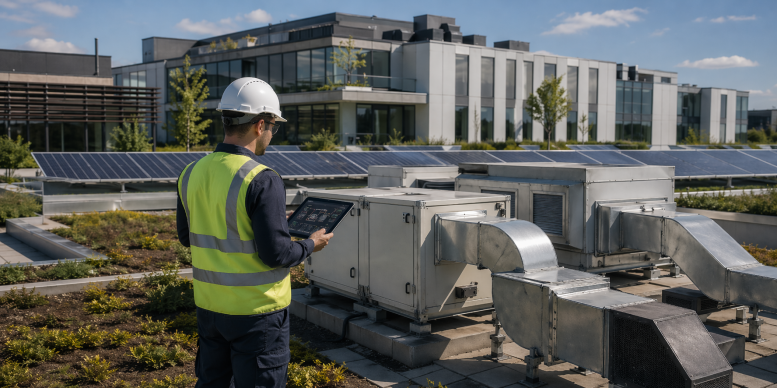
What are sustainable HVAC systems?
Sustainable HVAC systems build on the principles that govern how HVAC systems work —heating, ventilation, air conditioning and control—but apply them with a stronger focus on thermal comfort, indoor air quality, energy use and carbon emissions.
Increasingly, they rely on digital tools such as BIM, IoT and energy modelling to improve design accuracy, operational efficiency and lifecycle performance. In practice, these systems are essential to the delivery of net zero buildings.
From Hidden Installations to Critical Infrastructure
For decades, HVAC was often treated as a background system in building design. It was expected to work efficiently, remain largely unseen and require little attention once installed. When it performed well, occupants barely noticed it.
That invisibility, however, also encouraged a “fit and forget” mindset that too often compromised long-term performance. Poor design, weak integration and limited follow-up reduced the value of systems that are fundamental to occupant comfort and building efficiency.
That context has changed. Since the pandemic, awareness of indoor air quality has increased significantly. At the same time, stricter carbon targets, rising energy costs and rapid technological progress are pushing the sector towards smarter, more integrated HVAC solutions.
HVAC is therefore no longer just a hidden building service. It is increasingly recognised as critical infrastructure with a direct impact on health, comfort, compliance and energy performance.
Why the Modern HVAC Engineer Needs Broader Expertise
The role of the HVAC engineer has expanded well beyond conventional system design. Coordination with architects, structural engineers, civil engineers and façade specialists has always been important. Today, that multidisciplinary requirement is even more demanding.
Modern HVAC engineers are expected to work with dynamic thermal simulation, energy modelling, overheating analysis, BIM workflows, digital twins, IoT-enabled monitoring, façade engineering, engineered natural ventilation and carbon assessment, alongside the traditional performance, operational and regulatory requirements of HVAC design and installation.
This shift is reshaping the profession. The HVAC engineer is no longer responsible only for mechanical systems, but for helping buildings perform better across design, construction and operation.
Lifecycle Performance in Net Zero Buildings
Interest in lifecycle performance is growing across the built environment, especially in projects targeting net zero buildings. Design teams and developers are paying closer attention not only to operational energy use, but also to embodied carbon, long-term system efficiency and post-occupancy performance.
In many non-domestic buildings, HVAC remains one of the largest energy loads, often accounting for 40% to 60% of total energy consumption. For that reason, improving HVAC knowledge and system performance is critical to the future of building safety, efficiency and sustainability.
There is also a clear market dimension. Low- and zero-carbon buildings are increasingly seen as more resilient, more compliant and more attractive to investors, occupiers and clients. In that context, sustainable HVAC systems are becoming a strategic asset rather than a technical afterthought.
The Strategic Role of HVAC in Future Buildings
HVAC is no longer invisible. It sits at the centre of some of the most urgent challenges facing the construction sector: energy efficiency, indoor air quality, digital integration and net zero emissions.
Delivering better buildings will depend, to a large extent, on involving technically strong HVAC engineers from the earliest design stages and giving these systems the strategic importance they now require.