
Master's in Artificial Intelligence for Architecture & Construction
Double degree


Language
English
Duration
1 academic year
Starts in
May 2026
Credits
60 ECTS
Methodology
Live Online
Learn more about our Master’s in AI for Architecture and Construction
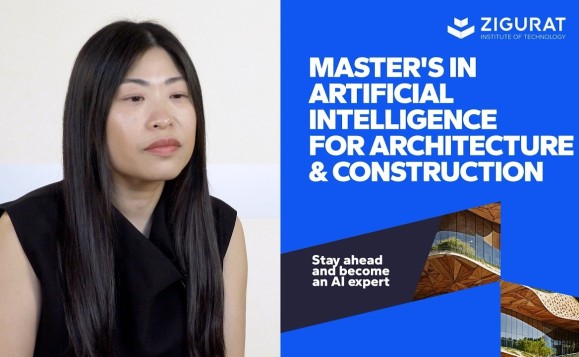
Join the Master’s in AI for Architecture and Construction and lead the new reality of the AEC sector.
This Master’s in Artificial Intelligence for architects and engineers prepares you to take the lead in the next step towards the digitalisation of the construction sector. Become an AI expert and develop tailor-made artificial intelligence solutions for building, infrastructure, or urban planning projects.
Integrate advanced BIM and AI, generative design, machine learning algorithms, and digital twins to become the AI specialist the AEC sector is already demanding. Master AI technologies to automate modelling, optimise costs and timelines, and make data-driven decisions in real time.
Stay ahead of upcoming trends: understand AI in architecture and construction and determine the best way to apply it for more efficient, innovative, and profitable projects.
You will have the support and knowledge of an expert, interdisciplinary, and international faculty board that will keep you at the forefront of technological advances that continue to emerge.
Dare to take the leap!





AI for Architecture and Construction Master’s Content
60 ECTS
Your journey as an AI and BIM expert starts here
Computational Logic and AI Fundamentals Applied to the AEC Sector
Key Areas of AI Applied to the AECO Sector
BIM and Generative Design Powered by AI
Disruptive Technologies: From Buildings to Smart Cities
Final Master’s Project in Artificial Intelligence for Construction
Our AI experts for the AEC sector

Master's Director
Lilian Ho
Directora Asociada | Líder Digital y BIM | Women in AI | Líder Regional y Mentora en Women in BIM

Andreas Horn
Director de AIOps en IBM

Shalini Goyal
Líder de IA y Directora Ejecutiva en JPMorganChase

Rui de Klerk
Lead Computational Designer en factorymaker

Sidrah Hassan
Asesora en Ética y Estrategia de Inteligencia Artificial en Ethical AI Alliance

Rogério Lima
Socio fundador y consultor en AECOTECH








-default-233x174.png)
-default-233x174.png)

Accreditations

Software














The ZIGURAT methodology
Active & Social Learning
Training based on participation and collaboration
Studying at ZIGURAT means expanding your professional network and having the unique opportunity to participate in selective working groups, decided on through the expertise of our professors: leaders in technological innovation and construction.
Lifelong Support
A holistic view of the professional profile
From the initial orientation to post-Master's advice, we guide you to have a critical and 360º vision of your future as an expert in the sector.
Online Experience
Interactive and flexible digital experiences
Through live sessions with industry leaders and high-quality materials on global case studies, our learning approach adapts well to the hybrid pace of today's professionals.
FAQ
Why study a Master’s in Artificial Intelligence applied to Construction for architects and engineers?
AI in construction is already having a major impact on the design, 4D/5D planning, construction, and maintenance phases. However, it has the potential to influence almost every process within an AEC project. The various technologies associated with AI make it possible to apply generative design, automation, predictive analysis, and digital twins to construction projects, boosting productivity and quality while reducing timeframes and costs.
Many generic AI solutions do not address the specific challenges of the AEC sector. This programme enables architects and engineers to develop artificial intelligence solutions tailored to the specific needs of their companies or projects, taking into account the unique characteristics of each business.
What are the applications of AI in architecture and engineering, and how is it integrated with BIM (AI + BIM)?
Artificial intelligence can be integrated with architecture and engineering, creating an interoperable BIM+AI environment. It automates modelling, validates and analyses models, processes IFC data, develops plugins, optimises BIM workflows with machine learning, and applies computer vision and NLP, among many other possibilities.
What specific applications does artificial intelligence have in construction?
AI in construction uses advanced algorithms, machine learning, and data analytics to optimise every stage of AEC projects.
From generative design, energy optimisation, efficient 4D/5D planning, risk detection, quality control, automation via robotics and the IoT, through to parametric urbanism, AI enables the improvement of sustainability, reduction of costs, and the taking of informed decisions in real-time. In this context, it becomes an essential tool for transforming the sector's productivity and innovation.
What professional profiles best fit this Master's degree in AI for Architecture and Construction?
Any architect, civil engineer, or urban planner with a technological profile who wishes to apply AI to real construction projects (building, infrastructure, or urban planning) and lead innovation within their team or company.
After the Master's in AI for Architecture and Construction, what AEC professional roles can one aim for?
This Master's degree in Artificial Intelligence for architects and engineers opens up many career opportunities:
Smart Building Specialist: Designs and manages projects that incorporate automated systems to improve energy efficiency, safety, and comfort in buildings.
AI Solutions Developer for Construction: Creates tools to optimise the design, planning, logistics, or maintenance of infrastructure.
Sustainability Director or Construction Innovation Director: Applies AI to optimise resource usage, reduce the carbon footprint, and efficiently manage the life cycles of buildings.
Innovation and Technology Architect: Leads the development and implementation of technological solutions in architecture and construction companies, optimising design, planning, and project management processes using AI.
What software will be used during the Master's degree in AI for architects and engineers?
Throughout the Master's in Artificial Intelligence for the AEC sector, students work with three categories of AI tools and software that are essential for professional practice.:
Programming and development environments: Google Colab, Jupyter Notebooks, and Visual Studio Code are used to implement scripts and workflows that support advanced automation and data processing.
Workflow automation and AI integration: N8N is applied to build intelligent automations and connect data across platforms through no code and low code solutions.
AEC and data analysis tools: Rhino and Dynamo support computational design, while Revit and ArcGIS enable BIM and GIS integration in real project workflows. Power BI is used for data visualisation and analytical decision making.
Do I need to know how to programme in order to enrol in the Master’s in AI for Architecture and Construction?
No. A technical foundation and some knowledge of BIM plus AI are recommended, although the introductory content in Block 0 will enable you to acquire the necessary basics. In addition, the programme provides students with solid knowledge in Python, data, and AI fundamentals applied to the AEC sector from the very beginning.
Your AI for Construction Journey Starts Here
Application for admission
Send us your application, your CV and a short presentation.
Personal interview
Our admissions team will arrange an interview with you.
Submission of documentation
Send us the necessary documentation to assess your application.
Admissions Committee
Our committee will evaluate your application.
Admission decision
If you meet the requirements, you will get your place.
Enrolment
Follow the enrolment steps indicated by the advisor.