ZIGURAT HVAC Congress 2026 analyses the future of HVAC in complex buildings
Categories
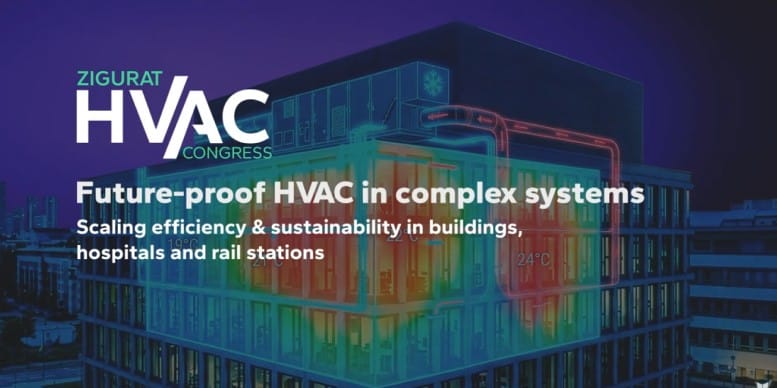
ZIGURAT Institute of Technology has held the first edition of the ZIGURAT HVAC Congress 2026, an online event dedicated to the role of HVAC systems in energy efficiency, sustainability and the operational performance of complex buildings and infrastructure.
Under the theme Future-proof HVAC in complex systems, the congress attracted more than 630 registered professionals from different countries to address how heating, ventilation and air conditioning, as well as indoor air quality, are no longer systems focused solely on comfort, but have become key elements in decarbonisation, occupant health and the efficient management of built assets.
The session focused on three particularly demanding areas: buildings, hospitals and railway stations, where HVAC design requires technical precision, data integration, sustainability criteria and a comprehensive understanding of the building life cycle.
HVAC, from technical system to critical infrastructure
During the opening of the congress, it was highlighted that around 40% of the energy consumed in modern buildings comes from HVAC systems, a figure that places this discipline at the centre of today’s efficiency and sustainability challenges.
The event featured two technical presentations. The first, Low-Carbon Consulting: The Journey to Zero Carbon Buildings, was delivered by Janet T. Beckett, Founder and Director at Carbon Saver Consultants Ltd and Programme Director of ZIGURAT’s Master’s in HVAC Systems with Energy Efficiency. With more than 30 years of experience in HVAC engineering and low-carbon design, Beckett has worked on international projects such as Liverpool City Library, Rome Convention Centre and Benfica’s Estádio da Luz.
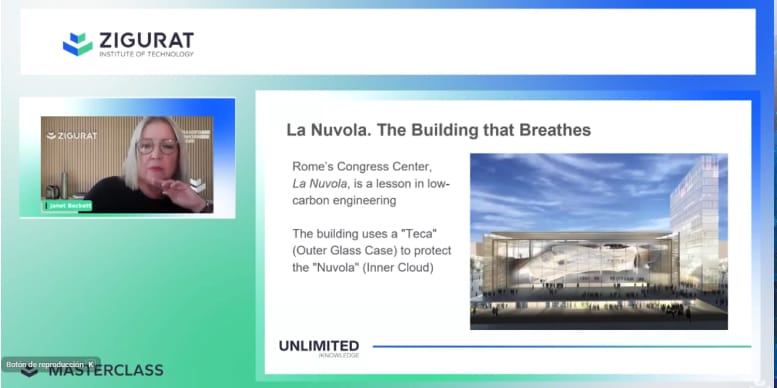
In her presentation, Beckett reviewed the evolution of low-carbon construction from the energy crises of the 1970s to today’s regulatory frameworks and sustainability standards. Her session addressed the impact of directives, regulatory frameworks, standards and methodologies such as the Energy Performance of Buildings Directive (EPBD), Approved Document L / Part L, CIBSE TM65, the UK Net Zero Carbon Buildings Standard and environmental certifications such as BREEAM, LEED, NABERS, Green Star and Pearl on the way more efficient buildings are designed.
One of the main messages of the session was the need to apply a design hierarchy that does not start with technology, but with an understanding of context. Beckett stressed the importance of first analysing the building’s global and local location, its occupants, its envelope and its passive strategies before sizing MEP systems or incorporating low- or zero-carbon technologies.
Through cases such as Rome Convention Centre and Liverpool Central Library, the speaker showed how HVAC design can be integrated from the early stages of a project to reduce energy demand, make use of passive strategies and improve the environmental performance of complex buildings.
Precision modelling for hospitals and critical infrastructure
The second presentation, Precision Modelling: ASHRAE Calculations vs. Reality, was delivered by Isaac Sesmero, MEP Engineer at Sener and lecturer on the same ZIGURAT master’s programme. His session focused on thermal load calculations and the selection of HVAC technologies in critical infrastructure such as hospitals, railway stations, tunnels and large buildings.
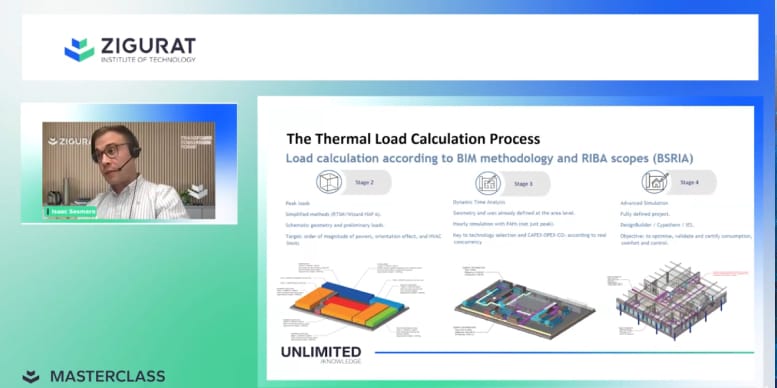
Sesmero explained that, in this type of project, HVAC systems do not only influence comfort, but also operational reliability, user safety, service continuity, investment cost, operating cost and the building’s carbon footprint.
The session analysed the evolution of thermal load calculation methods, from historical methodologies such as the Transfer Function Method to more advanced approaches such as the Radiant Time Series Method and the Heat Balance Method, considered the reference method for hourly simulations and design decisions in complex buildings.
Using a hospital case study, Sesmero showed how technical analysis must accompany each stage of a project: from a strategic estimate of loads and the initial definition of technologies to detailed zone-by-zone simulation, the assessment of use profiles, load simultaneity and the final optimisation of systems.
The case made it possible to compare different thermal production solutions, including boilers, chillers, heat pumps, air-source systems, geothermal systems, heat recovery and domestic hot water systems. One of the most relevant conclusions was that the solution that appears to be the most efficient from an energy perspective is not always the most appropriate when investment criteria, economic return, operation and actual emissions reduction are taken into account.
In this respect, the presentation underlined the importance of making decisions based on high-fidelity data and simulations adapted to real operating conditions. Precision in modelling makes it possible to adjust equipment sizing, avoid oversizing, optimise performance and improve the economic viability of HVAC solutions.
New skills for HVAC engineering
The congress also addressed the skills HVAC professionals will need in order to respond to the sector’s new demands. During the Q&A session, Beckett highlighted the importance of combining technical foundations — thermodynamics, fluids, refrigeration, thermal behaviour and energy efficiency — with new capabilities in software, data management, energy modelling, cost analysis, return on investment and regulation.
Artificial intelligence also emerged as a support tool to expand the capacity for analysis and comparison of alternatives. Rather than replacing expert judgement, the speakers agreed that new digital tools can help engineers present better options, assess more complex scenarios and make more informed decisions.
The ZIGURAT HVAC Congress 2026 forms part of the launch of the Master’s in HVAC Systems with Energy Efficiency, the English-language edition of the Máster en Climatización (HVAC) con Eficiencia Energética, which ranked second in El Mundo’s ranking in the Master’s in Energy category. It is a 100% online programme taught in English, whose first edition will begin in November 2026.
The programme responds to growing international demand for professionals capable of designing, modelling and managing efficient HVAC systems in complex buildings and infrastructure. Its approach combines engineering fundamentals, energy efficiency, sustainability, modelling, international standards and practical application in real projects within the AECO sector.
With this congress, ZIGURAT reinforces its commitment to advanced training in key areas for the digital and sustainable transformation of architecture, engineering and construction, connecting technical knowledge, professional experience and applied innovation.