
InfraBIM 2026: when BIM+GIS+AI stops being a “trend” and becomes a working method
Categories
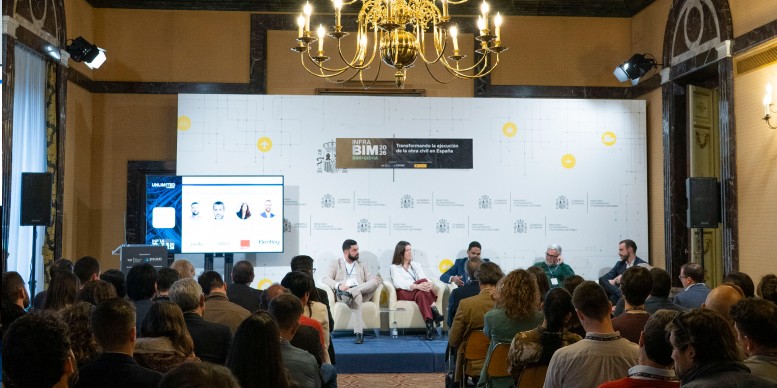
The latest edition of InfraBIM, the forum promoted by ZIGURAT Institute of Technology and the Madrid Association of Technical Civil Engineers (CITOP Madrid), once again brought together over a hundred industry professionals at Madrid’s Palacio de Zurbano, a venue made available for the occasion by Spain’s Ministry of Transport and Sustainable Mobility. Following the success of InfraBIM 2025 and previous editions, the 2026 event focused on a convergence that is already reshaping civil infrastructure: BIM + GIS + AI, understood not as “software”, but as a way to integrate reliable information to make better decisions across the infrastructure lifecycle.
The event was opened by Pau F. Aldomà, CEO of ZIGURAT Institute of Technology, and Óscar Carballo Ares, Dean of CITOP Madrid. Both highlighted the progress of BIM over the last decade and the role that public bodies, companies and education must play to consolidate real transformation. “This is about people,” was one of the messages that resonated throughout the day: without digital talent, leadership and adaptability, no technology can sustain change.
Carlos Dueñas Abellán, President of CITOP and Vice President of the Institute of Engineering Graduates and Technical Engineers of Spain (INGITE), opened the round of presentations by addressing the next milestones in the rollout of Spain’s BIM Plan and its driving effect on the market. His talk stressed a key point for technical teams: change is not only about modelling, but about managing high-quality information in an orderly way, with the right processes and prepared profiles. The result is a more productive sector, able to work with traceability, interoperability and a lifecycle approach (design, construction and maintenance).
From a “silent” digital twin to cognitive geospatial intelligence
Next, Juan Ramón Mena, CEO of Digital Mello, lecturer on ZIGURAT’s Master’s in Artificial Intelligence for Architecture and Construction and Master’s in Global BIM Management, and alumnus of ZIGURAT’s Master’s in BIM Management in Civil Engineering and GIS, presented an idea that connected with many of today’s challenges in civil works: digital twins often remain, in practice, little more than “models”—with limited operational value. To turn them into useful tools, he proposed a clear sequence: connect data sources (BIM, GIS, planning, site data, cost), standardise and govern the information, and apply AI as a layer for analysis and decision support (not as a “magic button”). Among the use cases he mentioned were computer vision to verify execution, predictive models to anticipate deviations, and assistants that allow teams to query project status with spatial context.
Round table: BIM, GIS and AI, synergies that multiply impact
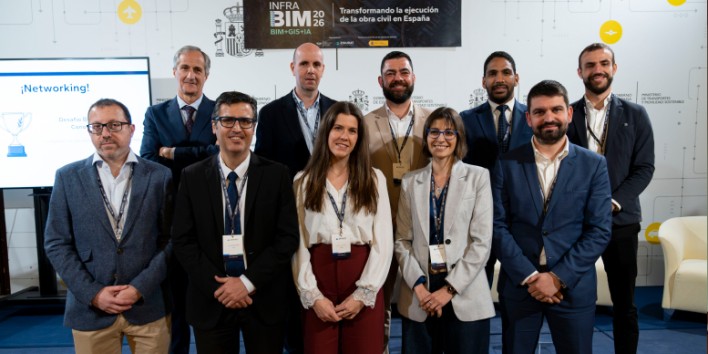
Moderated by Manuel Rojas, Secretary General of CITOP Madrid, the round table “BIM, GIS and AI: Synergies that Transform the Digitalisation of the Sector” brought together, alongside Juan Ramón Mena,Manuel Carpintero (BIM Manager at OHLA), Eva Orozco Ramírez (Digital Director for BIM GIS in Transport Infrastructure at TYPSA) and Sergio Cediel (Team Leader at Bentley), all of them alumni of ZIGURAT’s BIM Management master’s programmes.
The discussion distilled several lessons applicable to organisations driving digital transformation:
– Integration is already a reality, but it is not homogeneous. The sector coexists with different maturity levels, and requirements and deliverables are still sometimes poorly aligned with real use.
– Semantic and topological interoperability: it is not enough to “see everything together”; data must retain identity, attributes and spatial relationships across platforms.
– Data governance and cybersecurity: value depends on how information is structured, validated and protected.
– Human validation: in engineering, AI accelerates analysis, but technical responsibility requires supervision and professional judgement.
Case studies from Madrid, London and the Washington, D.C. area
The second part of the event turned to concrete examples. Álvaro Ruiz López, Head of the Technical Unit for Transport Infrastructure Works (Directorate-General for Collective Transport Infrastructure, Community of Madrid), explained how BIM is being implemented through public procurement and applied to highly complex urban projects such as the extension of Madrid Metro’s Line 11. The presentation showed the value of incorporating clear requirements, roles and information-management processes to sustain coordination on site and move towards more efficient asset operation.
Victoria Morenate, Director of the BIM Department at TYPSA and alumna of the Master’s in BIM Management in Civil Engineering and GIS, shared the information-management approach used on the London–Birmingham high-speed rail project (HS2), highlighting the importance of traceability, approval workflows within common data environments, and quality control in information delivery.
Ignacio Gutiérrez, Digital Construction & Data Management at Ferrovial, presented the case of the I-66 Outside the Beltway highway project (USA) and how a “digital delivery” approach enables teams to move from scattered documentation to data-rich models that support design, construction and continuity into operations, especially in projects where the main constraint is building while keeping traffic flowing and minimising disruption.
Speakers and attendees agreed on a clear message: BIM+GIS+AI is not “the future”, but the accelerator of the present. Yet for it to work, the sector needs what was heard repeatedly throughout the event: data governance, auditable processes, continuous training, and professionals capable of leading change with sound technical judgement.