
More than 700 professionals from over 100 countries attend the second edition of the ZIGURAT AI Congress
Categories
ZIGURAT Institute of Technology has held the second edition of the AI Congress for Architecture & Construction, an international online event that brought together more than 700 professionals from over 100 countries around a shared challenge: how to apply artificial intelligence in an effective, safe and measurable way in AECO projects.
To facilitate global participation, the congress was held in three sessions: in Spanish, Portuguese and English. The first two took place on 18 March, while the English session was held on 25 March.
Following the success of its first edition, the AI Congress is consolidating its position as a key forum to analyse the real impact of artificial intelligence in architecture, engineering and construction, with a focus on practical application and data-driven decision-making.
The challenge of AI in AECO: data quality
One of the main conclusions of the congress was that the current challenge for the sector no longer lies in the availability of technology, but in the quality, organisation and use of data.
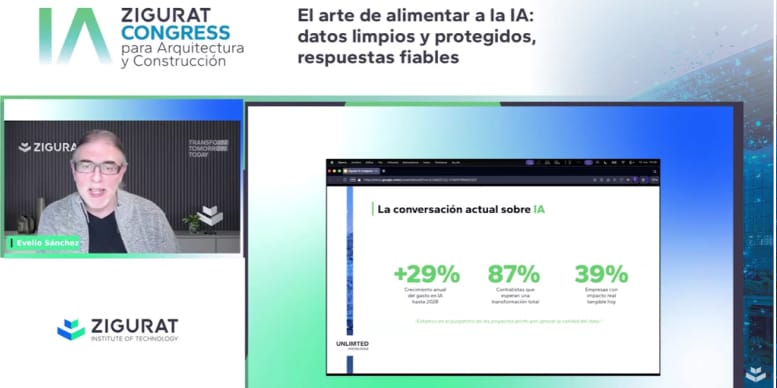
In this regard, Evelio Sánchez, specialist in technology applied to the AECO sector and lecturer on ZIGURAT’s Máster en Inteligencia Artificial para Arquitectura y Construcción, highlighted during the Spanish session that “artificial intelligence amplifies the quality of existing data: if the data is flawed, the errors multiply”, underlining the need to work with structured and reliable information to avoid negative impacts on projects.
This reflects a growing reality across the sector: digitalisation has advanced significantly in recent years, but it has not always been accompanied by a solid data management strategy.
During the English edition, experts focused on another critical risk: the misinterpretation of data.
Thiago Caldeira, Director of AI Solutions at Contango, warned that “data is not the only problem, the real challenge is how to extract meaningful insights from it and turn them into action”, highlighting the difficulty of transforming large volumes of information into reliable decisions.
He also noted that correlation does not imply causation, an aspect particularly relevant in complex environments such as construction projects, where decisions based on incorrect conclusions can directly impact costs, timelines and outcomes.
Meanwhile, during the Portuguese edition, Ítalo Guedes, Deep Learning specialist, director and lecturer of the Master em Inteligência Artificial para Arquitetura e Construção at ZIGURAT and Executive Director of IG Consultoria, explored how AI systems are built on data rather than algorithms alone, particularly in the fields of machine learning and deep learning. Guedes stressed that “data is the foundation of any artificial intelligence system: if we do not understand how to acquire, prepare and structure it, it is very difficult for models to perform properly. In fact, up to 80% of the effort in AI projects is devoted to data processing.”
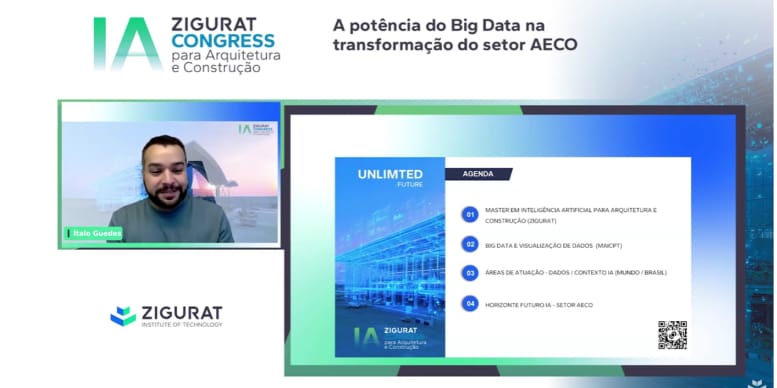
This perspective highlights one of the main gaps in the AECO sector: the distance between the generation of digital information — through BIM models or other tools — and its real capacity to be used as a foundation for intelligent systems.
From potential to implementation: the real challenge
Beyond technical analysis, the AI Congress highlighted the need to move from experimentation towards the real implementation of artificial intelligence in projects.
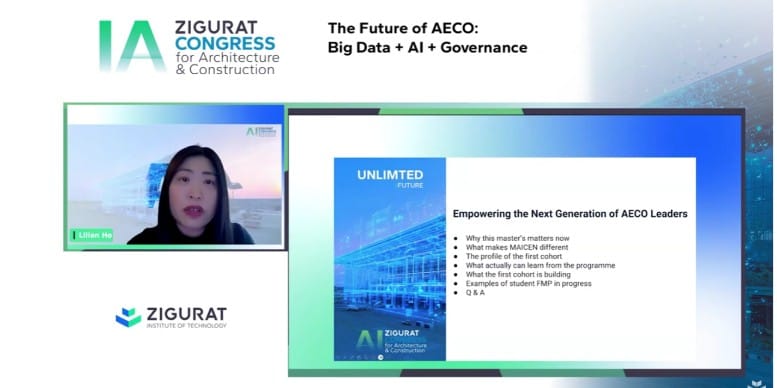
As explained by Lilian Ho, Associate Director Digital & BIM Lead at AECOM and Director of the Master’s in Artificial Intelligence for Architecture & Construction, there is a need for new professional profiles capable of connecting technology, data and decision-making, in a context where the sector is under increasing pressure to improve efficiency, sustainability and productivity.
In the same vein, Fernando Iglesias, Director of the Spanish edition of the Master’s in Artificial Intelligence for Architecture & Construction (Máster en Inteligencia Artificial para Arquitectura y Construcción) at ZIGURAT, emphasised that the current challenge lies in properly structuring data and processes so that technology can deliver value throughout the entire project lifecycle.
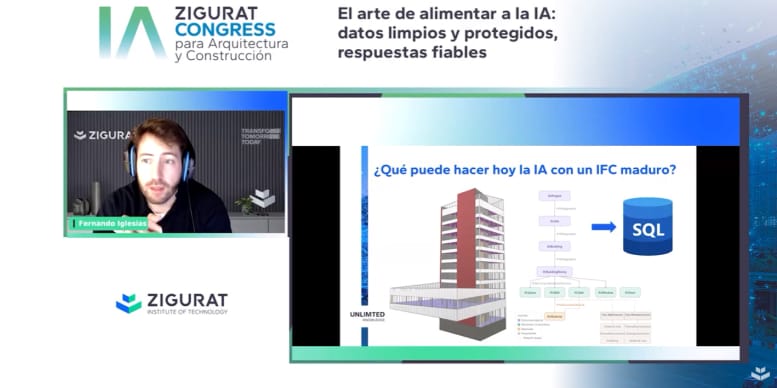
The congress also addressed a key issue in the use of AI: ethics and the need to integrate governance criteria.
In this regard, Belén Pérez, Senior GRC Consultant at Govertis (Telefónica Tech), stated that “before using artificial intelligence tools, it is essential to understand what we can and cannot do, and to always prioritise security”, highlighting aspects such as data protection, intellectual property and the risks associated with external platforms.
For her part, Sidrah Hassan, AI Ethics and Strategy Advisor at Ethical AI Alliance, stressed that the adoption of these technologies must be accompanied by regulatory frameworks and clear principles to ensure responsible use, in line with regulations such as the EU AI Act and GDPR.
The strong interest from attendees, coming from over 100 countries, reinforces the AI Congress as a global meeting point for professionals seeking to understand how to integrate artificial intelligence into their workflows in a strategic and secure way.
At a time of accelerating digital transformation in the AECO sector, the congress leaves a clear conclusion: artificial intelligence alone does not create value; it is the combination of high-quality data, governance and expert knowledge that determines its real impact on projects.